It was during the early
cable TV days when I was producing documentaries
and visiting different sites in the Americas. One
trip brought me to Cartagena Colombia where officials
were looking for more media publicity because the
drug cartels had severely hurt tourism.
 It
certainly didn’t take long after 1492 for the
Spanish conquistadors to discover the gargantuan
hordes of gold, silver and precious gems in the
new world. As early as Columbus’s 3rd voyage,
one of his crew, Alonso de Ojeda, became the first
European to reach Colombia in 1499, followed by
Rodrigo de Bastidas who settled Santa Marta in
1525, and Pedro de Heredia who founded Cartagena
in 1533.
It
certainly didn’t take long after 1492 for the
Spanish conquistadors to discover the gargantuan
hordes of gold, silver and precious gems in the
new world. As early as Columbus’s 3rd voyage,
one of his crew, Alonso de Ojeda, became the first
European to reach Colombia in 1499, followed by
Rodrigo de Bastidas who settled Santa Marta in
1525, and Pedro de Heredia who founded Cartagena
in 1533.
Despite abuses from colonizers such as
Britain, Holland, France and Portugal, no colony
experienced more tragedy that those at the hands
of the Spanish conquistadors. The “site of massacres’
signs in Colombia, Venezuela, Mexico and many
islands attest to the policies of Cortes, Pizarro,
Balboa, Ponce de Leon and dozens of lesser known
figures. Historians estimate over 56 million native
deaths by 1600 with the population of Peru falling
from 9 million to 600,000 by 1620 and that of
Central Mexico from 10-25 million to 1 million
during the same period.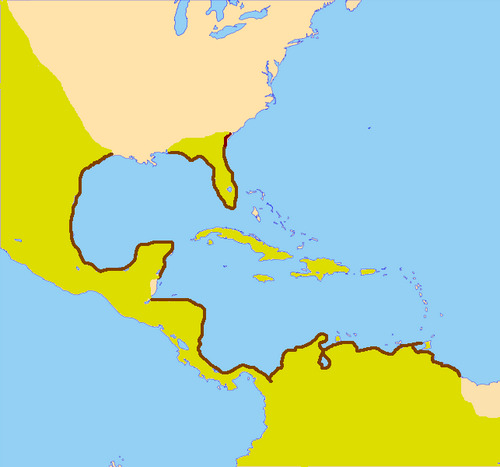
What amazed us in Cartagena were the
incredible efforts made by the Spanish to protect
their immense stolen wealth. From all over their
colonies in the Caribbean, treasure was collected
and brought to the city where the ships of the
Spanish Main loaded up and sailed to Cartagena,
Spain with their gold, silver and emeralds. This
cascade of riches made Spain the wealthiest country
in Europe in the 16th century increasing their
money supply tenfold. And in 2026, Spain is still
the world’s leading emerald supplier.
With these numbers in mind it became
easier to understand why they took such huge measures
to protect the city from pirates and Europeans
(British, Dutch etc.). They built a huge underwater
wall Escollera de Bocagrande (where their many
slaves died -- no scuba gear in the 16th century)
a mile from the beach so invading  ships
could not approach. They erected the largest fort
in the continent -- Castillo San Felipe which
supported a huge maze of tunnels (viewable in
the film “Romancing the Stone”) to hide movements
of gold and silver.
ships
could not approach. They erected the largest fort
in the continent -- Castillo San Felipe which
supported a huge maze of tunnels (viewable in
the film “Romancing the Stone”) to hide movements
of gold and silver.
The conquistadors were insatiable in
their greed for everything from gold nose plugs
to secret idols. As one contemporary native source
quotes “The Spaniards took things from people
by force . . . They were looking for gold.”
Although it is difficult to establish
the reasons for Spain’s extreme colonial brutality,
some factors can be seen. The power that Catholic
Spain had during this period crystallized with
the Inquisition whose sadism inspired the Requerimento
policy. This blueprint held that violence was
a legitimate tool to punish ‘infidels’ and ‘barbarians’”
who would not convert to Catholicism. Conquistadors
seeking gold obviously used this pretext among
others to inflict genocidal massacres in order
obliterate huge populations not only in Colombia
but all over the Caribbean.
The connection between the ruthless conquistadors
of yore and contemporary Spanish dictators (Noriega,
Pinochet, Maduro, de Rosas, Calles and countless
others) can be seen when the practice of Caudillismo
is understood. This was a political system in
former Spanish colonies in Latin and South America
characterized by rule through charismatic, strong
military leaders called Caudillos who
wielded personal power, often bypassing formal
institutions, relying on personal loyalty, military
force and paternalistic clientelism to maintain
control, leading to instability but assuring loyalty.
The system gained strength when Spain decolonized
and independent nationals took over.
Some numbers of the monies gained by
Spain colonizers can be helpful in comparing their
wealth to that of contemporary drug cartels not
only in Colombia but also in Mexico, Venezuela
and elsewhere in the Americas. Unfortunately only
approximations are possible but even low estimations
yield disturbing results. From 1500 to 1650 Spain
was said to have brought home 180 tons of gold
and 16000 tons of silver -- triple the European
silver reserves and having a value of 24-25 billion
US dollars. There are no verifiable estimates
of the value of gems, tobacco, lumber they plundered
but according to several sources the amount could
very well be between 5 to ten billion. Of course
this 150 year period is less than half their time
as new world colonizers so these estimated monies
are only part of their huge extraction of wealth
from there.
By contrast, analysts estimate the criminal
the value of synthetic opioids, dominated by fentanyl
trafficking, run into tens of billions of dollars
per year even though precise numbers are hard
to quantify.
Thus, the modern Caudillos of
former Spanish colonies are gleaning billions
as they insidiously draw on the tradition of Requerimento.
As of old, modern massacres of populations continue,
and incalculable wealth is gained by the cartels
and political dictators. Only this time, with
the exportation of cocaine and fentanyl, the rest
of the world suffers.
This legacy of Caudilloism whereby Latin
and South American dictators continue to exert
the aforementioned evil power over their populations
is destined to continue unless some other kind
of government system replaces it. There is no
indication that this will happen soon.
Given this history and the present-day
versions of Caudilloism, it should be obvious
to enlightened politicians, statesmen and ministers
that only a truly intellectual and meaningful
understanding of the history and real problems
in Latin and South America can benefit the people
and the hemisphere. The recent events in Venezuela
have drawn attention that, and perhaps some meaningful
changes could possibly occur. However, regime
change” in order to obtain control of oil would
simply replicate the policy of Caudilloism --
by whoever instigates that change.