Political
conspiracy has existed in human societies since time
immemorial. Presently, Putin and fellow conspirators
have been maneuvering well-known rhetorical and conspiratorial
formulas in connection with the Ukraine crisis. His
narratives blame NATO, the west, “Nazis” and “foreign
agents” as he draws upon ancient Russian conspiracy
practices as old as the Czars who censored Tolstoy’s
books and imprisoned Dostoyevsky for questioning the
royal authority.
After the Czar was overthrown by the communists, Marxian
idealism was suborned by corrupt Bolsheviks who adopted
it only because it would allow them to gain power.
After dethroning the Czar, they abandoned Lenin, yielded
to Stalin’s tyranny and his imperialistic creation
of the Soviet Union in 1922, and embraced an archetypical
conspiracy group often referred to as the K.G.B. Putin
is a former head of the K.G.B. After he became President,
Putin reorganized the K.G.B., rechristened it as the
F.S.B. (Federal Security Service) and had the head
of it report directly to him.
I had only a few notions about this conspiratorial
narrative until I traveled on business to Russia
shortly after the demise of the Soviet Union in
the early 90s. I was a corporate director of an
entertainment company which owned radio stations,
comedy clubs, and other 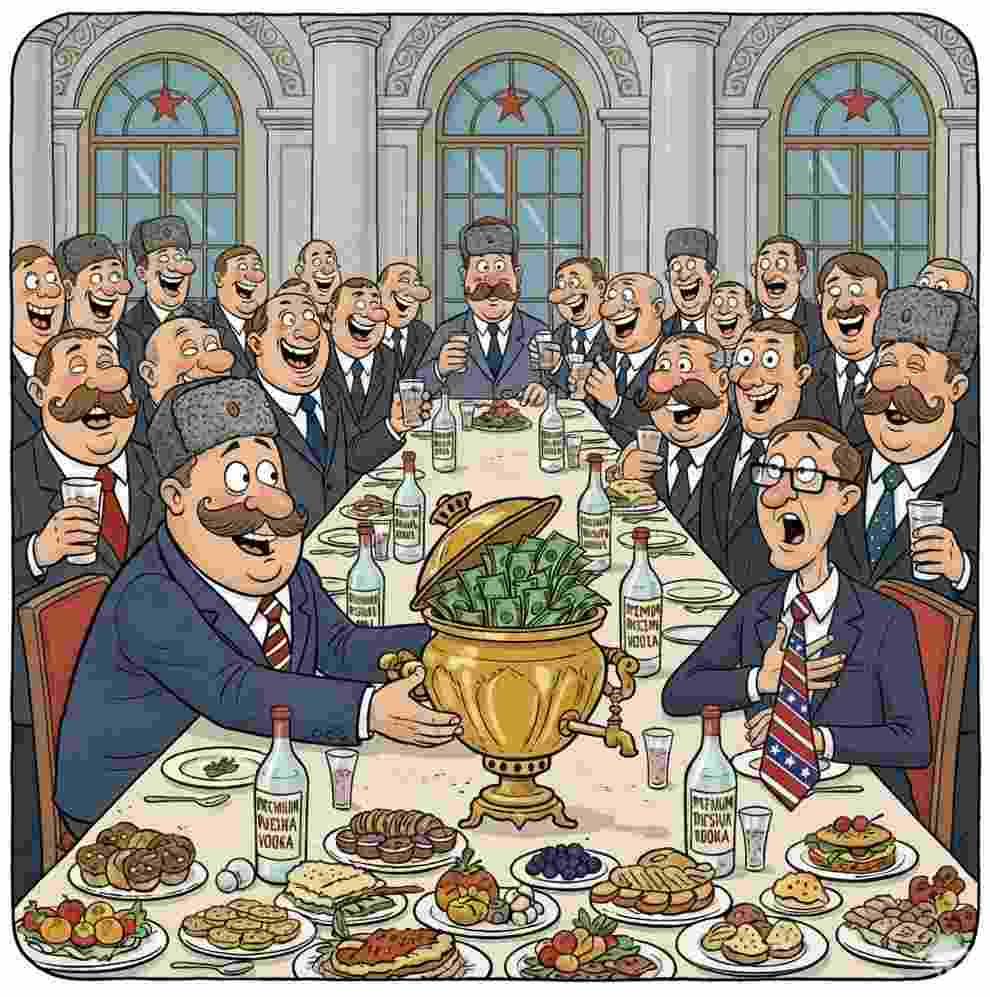 small entertainment companies. The chairman of the company
had met some Russian businessmen who wanted to reorganize
Russian radio programming, and increase exposure
to western music, particularly jazz. I initially
met the Russians in New York and then I was asked
to travel with them to Moscow to help with the programming,
examine their technology, and discuss further media
projects. I took along an interpreter and an engineer.
small entertainment companies. The chairman of the company
had met some Russian businessmen who wanted to reorganize
Russian radio programming, and increase exposure
to western music, particularly jazz. I initially
met the Russians in New York and then I was asked
to travel with them to Moscow to help with the programming,
examine their technology, and discuss further media
projects. I took along an interpreter and an engineer.
I was
somewhat taken aback when I arrived in Moscow and
was met by a cadre of extraordinarily well-dressed
businessmen who chauffeured me in large Mercedes
limos, registered my group at an impressive western-style
hotel, and commandeered the clearly dragooned staff
of an excellent restaurant to serve us an outstanding
dinner. It was December and the weather reported
a temperature of minus18 below Fahrenheit.
During the next few days in Moscow I helped organize
matters with deejays and engineers at Radio Seven
-- the first private radio station in the country.
I was then asked to travel to Saratov some 600 miles
away on the Volga. I was puzzled when I discovered
that I and only one executive would travel in a time-consuming
rickety train instead of a plane. Almost immediately
after we boarded my Russian counterpart invited me
into his cabin and initiated an all-night scrutiny
about the specifics of expenses, credit priorities
and stock purchasing. He kept droning all night, cleverly
but indirectly, insisting that the financial arrangements
he had agreed upon with my chairman back in America
had to be modified during this lengthy train meeting.
I finally insisted on getting some sleep and retired
to my berth. I couldn’t understand why he did this
until much later my interpreter explained that this
exhausting encounter was a standard approach in negotiating
business advantages.
Saratov was a city that wasn’t on any map. It billeted
some Russian atomic scientists and facilities and
the authorities were afraid that enemies could bomb
it. The other businessmen who had met me in Moscow
(and had flown to Saratov) gathered there and told
me a radio station, which would have to be financed
by Americans, could be erected using communist radio
towers built to jam western radio broadcasting of
the Voice of America.
At this point in my visit I began to experience significant
unease. I was surprised the following day when I was
the favoured guest at a huge reception that included
an orchestra and local dignitaries with whom I exchanged
small diplomatic gifts. After a well-organized dinner,
during which I was given extravagant compliments for
my academic and business career accomplishments, several
members of the group spoke and noted some past specifics
about my work. I was amazed because some of the information
they mentioned had been confidential and restricted
by my employers for years but they had somehow found
it.
After the speeches, which were obviously designed
to be respectfully intimidating, the leader of the
group handed me a large envelope which I discovered
was stuffed American money in $20 and $50 bills. Later,
my interpreter explained that this payment (by my
reckoning it was bribery) was standard business practice.
I then privately herded the leader into the lobby
and told him I couldn’t possibly accept the envelope.
He was confounded by my refusal. He seemed surprised
that I thought accepting this money was unethical
and also seemed personally offended. Later, we had
an extended discussion on business ethics and he tried
convincing me that such gifts were perfectly legitimate
and even principled in his experience.
I was very glad that my trip would end the following
day. When I arrived home I spent considerable time
with more experienced businessmen and soon discovered
that much of the activity (the voluptuous hospitality)
was par for the course.
Since that visit (which concluded with me convincing
my fellow executives in America to abandon dealing
with these characters) I’ve become extremely aware
and circumspect of Russian politics and international
business. Also during my trip, despite my having tournament
success in chess, I was completely demolished in games
with a few Russian grandmasters. To say the least,
I left Russia with a great respect for their talented
toughness and capacity for intrigue. But I gained
knowledge of their business and political chicanery.
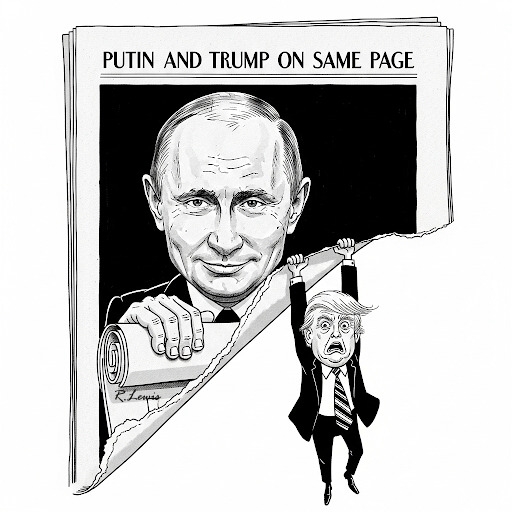 The
recent meeting between Putin and Trump drew me in
because it was a high- level enactment that eerily
reminded me of my own experience. Putin’s patent
smiling, his reference to Alaska as having a “Russian”
heritage, his comment that a future meeting could
be in Moscow, his insistence that his government
also wanted peace, all completely flummoxed Trump.
During their “cease-fire” meeting, Putin had actually
ordered more intensive bombing of Ukraine!
The
recent meeting between Putin and Trump drew me in
because it was a high- level enactment that eerily
reminded me of my own experience. Putin’s patent
smiling, his reference to Alaska as having a “Russian”
heritage, his comment that a future meeting could
be in Moscow, his insistence that his government
also wanted peace, all completely flummoxed Trump.
During their “cease-fire” meeting, Putin had actually
ordered more intensive bombing of Ukraine!
History
often teaches. In the 1938 Munich Agreement, Hitler
charmed England’s Neville Chamberlain and soon seized
Czechoslovakia’s Sudetenland after Chamberlain had
announced that the meeting had achieved “Peace in
our time.”
Trump has met with Putin at least six times and each
time come away empty. His knowledge of the history
of Russian conspiracies and the rhetorical and politically
disingenuous practices engineered by Putin is non-existent.
At this writing Russia has violated the air space
of Poland and Estonia in actions which observers have
deemed underscores he desire to recreate the territorial
expanse of the old Soviet Union.