Noam Chomsky
Mark Kingwell Charles Tayler Bruce
Bawer
Naomi Klein
Arundhati Roy
Evelyn Lau
Stephen Lewis
Robert Fisk
Margaret Somerville
Mona Eltahawy
Michael Moore
Julius Grey
Irshad Manji Glenn Loury
Richard Rodriguez Navi Pillay
Ernesto Zedillo
Pico Iyer
Edward Said
Jean Baudrillard
Bill Moyers
Barbara Ehrenreich
Leon Wieseltier
Nayan Chanda
Charles Lewis
John Lavery
Tariq Ali
Michael Albert
Rochelle Gurstein
Alex Waterhouse-Hayward
toxic race relations
IN THE HEAT OF THE NIGHT (1967)
Roger's
reviews have appeared in McClatchy-Tribune News
Service, Orlando Sentinel, Spin Magazine, The World,
Orlando Magazine Autoweek Magazine among others.
He is the founder and editor of Movie
Nation.
Listen to an audio version of this essay:
“In
the Heat of the Night” is one of those classics
that does not fade in the memory. Yes, it’s a
thriller with a murder mystery at the heart of it. But
“whodunnit” is immaterial to the film’s
thrills, and the one thing I seem to forget every time
I watch it anew.
Re-watching
this five-time Oscar-winning time-capsule of the 1960s
South during Oscar season is a reminder of how sometimes
the Academy gets it right, even on a Best Picture winner
which they made a collective blunder on that hangs over
it more than half a century later.
How
in the Hell did they not nominate Sidney Poitier for
this, the jewel in his acting crown? Even if he had
a statuette already on his mantelpiece, the omission
is as glaring as the film’s Southern Racism —
then and now — messaging.
Senior
citizens, especially in the South, still gravitate to
the Carrol O’Connor/Howard Rollins TV series that
took this movie and watered it down for 1980s and ’90s
audiences, almost a “post racial” take on
a movie that was all about race. But Norman Jewison’s
film exists on a whole other plane, an acting showcase
that made the smartest cop, the most educated and articulate
man in town a Black visitor, played by Poitier at his
Matinee Idol peak. So yeah, he was the best looking
man in town, too.
An
outsider with money and a plan for a factory that will
bring jobs to backward Sparta, Mississippi is murdered.
The gum-snapping police chief (Best Actor Rod Steiger)
is new enough on the job to be frantic for suspects.
One
of the people rounded up is a Black man in a suit. It’s
hard to imagine the jolt this movie provided to audiences
in the ’60s when it turns out the visitor, waiting
for a train to go back home, is a Philadelphia police
detective. He withholds this information from the yahoo
cop (Warren Oates) who picked him up, and delays it
just long enough to humiliate the racist chief.
The
film’s genius is having the chief self-aware enough
to recognize, based on a couple of the Black man’s
simple observations, that this is a much smarter cop
than him. And if he won’t admit it freely, he’s
sure as shooting talking Det. Virgil Tibbs’ Philadelphia
boss into making him “assist” in the investigation.
Tibbs,
through gritted teeth, shows up the cops, the “doc”
doubling as coroner, and the South in general with his
professionalism and willingness to put personal antipathy
aside in investigating this murder.
But
for the first time ever, the “noble” Black
man archetype has an edge. There’s only so much
he’s going to take. An infamous slap famously
is returned in kind, his unspoken disdain for “sleepy
time Down South” laziness and small town venality
and incompetence, Poitier’s Tibbs was an indictment
of “the way things have always been.”
It’s
left to the wealthy industrialist’s widow from
“up north” (Lee Grant) to say out loud what
Tibbs must be muttering under his breath.
“My
God, WHAT kind of people are you? What kind of place
is this?”
There
will be no railroading the first “likely”
suspect (Scott Wilson of “In Cold Blood,”
“The Right Stuff,” “Junebug”
and “Monster”). Not this time. Not with
a sharp cop who can see through the prejudices and police
“profiling” and general eagerness to grab
someone and make the charge stick, no matter what.
Watching
the film now, with the racial slurs often edited-out
even though white supremacists and Twitter have brought
them back, it’s impossible to miss the messaging
that the film still hammers home. Nothing will change
for the better in the still-backward corners of the
country until bigotry is set aside and every voice heard
from, every citizen’s potential is allowed to
flourish.
Steiger
makes Chief Gillespie a simmering stew of resentment,
sarcasm, outrage and panic. He’d like nothing
better than to drop a few more “n words”
on Tibbs and pack him on his way, maybe even let the
redneck mob have a go at him.
But
no, he needs him, and Steiger never lets the viewer
forget how much that infuriates and dismays him.
Poitier
didn’t get an Oscar for this, one of the all time
great screen performances. But that seems small potatoes
55 years later. Wherever else his career had been, wherever
else it would go, “In the Heat of the Night”
would make him an icon, mourned the world over when
he passed away last year.
He
was a big enough star to ensure this movie was not filmed
in the still-deadly-for-Black-people South, so Sparta,
Illinois doubled for Sparta, Mississippi. He fought
to ensure the slap heard all over America stayed in
“every print” of the movie, no matter where
it played.
And
he is the reason to try and talk the elderly relatives
into eschewing the namby pamby murder-of-the-week TV
version of “We all get along now” Sparta.
If Poitier’s name isn’t over the title,
and Ray Charles isn’t singing the title tune,
move along.








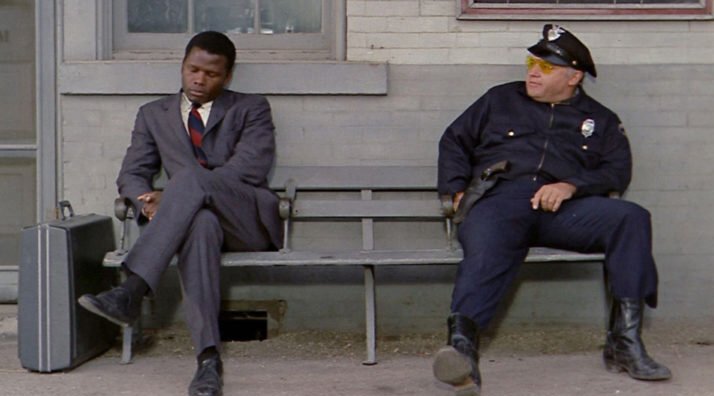 How
in the Hell did they not nominate Sidney Poitier for
this, the jewel in his acting crown? Even if he had
a statuette already on his mantelpiece, the omission
is as glaring as the film’s Southern Racism —
then and now — messaging.