Roger's
reviews have appeared in McClatchy-Tribune News
Service, Orlando Sentinel, Spin Magazine, The World,
Orlando Magazine Autoweek Magazine among others.
He is the founder and editor of Movie
Nation.
The
American master John Huston was an Oscar winning director
and screenwriter, and no slouch as an actor. A bon vivant,
boxer, horseman and at his richest, a member of the
Irish landed gentry, he became Hollywood’s most
famous Renaissance Man.
But
the one thing he studied, academically in Paris and
not from watching his father and learning to act on-the-job
appearing in plays with the old man, was painting. You
can see that painterly eye in just a few of his films
— “Fat City,” “The Dead,”
“The Red Badge of Courage” and most famously
“Moulin Rouge.” Most of his movies are best
remembered for the casting, clever plotting and classic
performances.
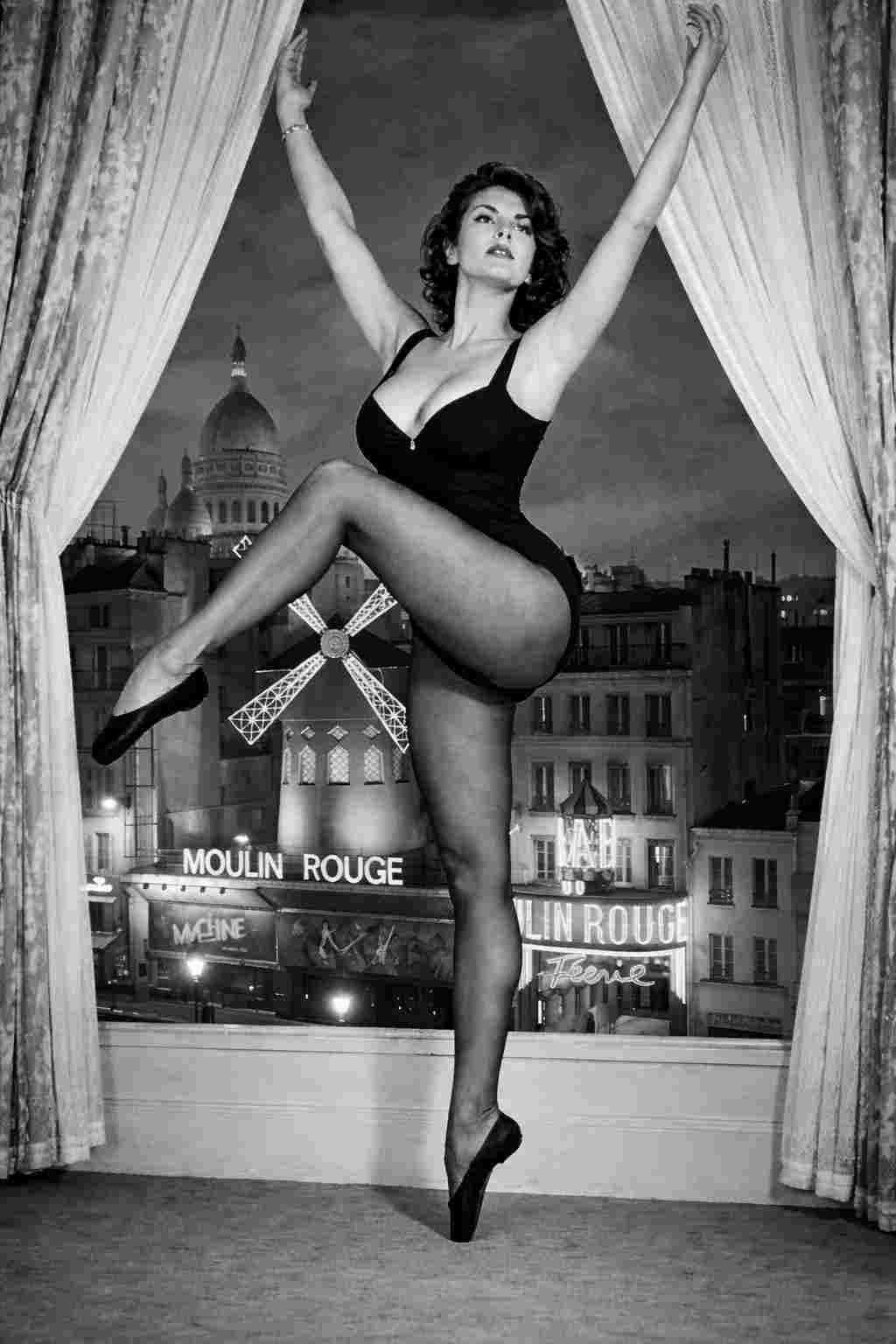 In
“Moulin Rouge,” the French-trained painter
turned playwright, writer, director and actor and his
art director (Paul Sheriff) and production designer/set-director
Marcel Vertès turned Technicolor loose on a tale
of Henri de Toulouse-Lautrec, the brilliant painter
and illustrator who documented Belle Époque Paris
— its lurid street life and gaudy night life,
most famously in posters and paintings of the notorious
nightclub and its habitues.
In
“Moulin Rouge,” the French-trained painter
turned playwright, writer, director and actor and his
art director (Paul Sheriff) and production designer/set-director
Marcel Vertès turned Technicolor loose on a tale
of Henri de Toulouse-Lautrec, the brilliant painter
and illustrator who documented Belle Époque Paris
— its lurid street life and gaudy night life,
most famously in posters and paintings of the notorious
nightclub and its habitues.
“Moulin
Rouge” (1952) is an adaptation of a fictionalized
biography of Toulouse-Lautrec, a picture both hopelessly
conventional in the ways of 1940s and ’50s bio-pics,
and garishly and gloriously “painted” in
strokes and colors the disabled, diminutive painter
worked in.
The
emphasis is on the melodramatic arc of the Toulouse-Lautrec’s
life — a child of privilege and nobility injured
in a fall which, coupled with the fact that his “noble”
parents were first cousins, left him with barely functional
legs, stunted in their growth due to bone breaks that
never “knitted.”
That
marked him for life and in the script’s telling,
left him a loner, an artist moved by the lives spinning
around him, but bitter that the women who made time
for him were almost certainly “using” him.
“Oh,
Henri why can’t you be tall and handsome?”
One
or two more drinks, Henri cracks, and “I will
be.”
Jose
Ferrer’s Oscar-nominated performance as Toulouse-Lautrec
(and as Henri’s disapproving father) is mostly
remembered for the little man stunt of it all —
trick shots, walking in ditches, seen standing on his
knees with his feet strapped behind his thighs. But
nobody of his era managed oversized performances quite
like Ferrer. His “Cyrano,” the towering
defense attorney turn in “The Caine Mutiny,”
the man’s florid baritone and steely gaze made
him perfect for “larger-than-life.”
“Marriage
is like a dull meal with the dessert at the beginning,”
the sad but witty loner insists. “I have it on
the very highest authority.
Colette
Marchand plays the street-walker Marie, a woman who
turns gratitude for his gallant “rescue”
of her from the police into something resembling love.
But muse or not, she’s almost certain to be faithless
and sure to use him and leave him even more broken.
Suzanne
Flon portrays a Myriamme, a more soulful and warm flirtation,
but one treated by him with the same bitter cynicism
that she’ll choose another, first chance she gets.
Huston
treats us to the spectacle of Zsa Zsa Gabor as a beautiful,
vain blonde chanteuse, a star of the Moulin Rouge (Red
Windmill) club. Her character, Jane Avril, was famous
for her Can Can. Here, she’s a singer, with her
singing voice dubbed by dancer/actress Muriel Smith,
whom Huston and Co. cast (along with an unnamed Black
male dancer) to remind viewers that Paris nightlife
was more integrated than it was in 1950s America.
The
scenes in the club are the life of this movie, with
Toulouse-Latrec at his customary table, effortlessly
sketching the whirl of legs, petticoats and dancer’s
bottoms, with various strata of Paris society ogling,
whistling and caught up in the gay maelstrom kicking,
splitting and spinning around the dance floor.
The
first third of “Moulin Rouge” plunges us
into this milieu, showing us faintly caricature-worthy
faces (Tutte Lemkow, wearing prosthetics that make him
almost grotesque) that the painter immortalized, introducing
amazing dancers (Katherine Kath and Muriel Smith) and
their petty, venal (and racist) rivalry.
The
flashbacks to the artist’s childhood and domestic
scenes of him drinking and bickering with Marie dominate
the middle acts, overwhelming a brief encounter with
his painting contemporaries (Christopher Lee plays the
pointillist Georges Seurat) and the late-life breakthrough
for the artist is lost in the lonely “dissipation”
that is the film’s dominant theme.
“I
drink. A little more each day. Thus, I forget my loneliness
and my ugliness and the pain in my legs.”
Every
scene in the club crackles with bawdy, PG-13 life, and
the best hope for most of those scenes not set in the
colorful chaos of what became — thanks to Henri’s
posters (the movie insists) — the hottest club
in Paris is that they be witty. About half of them rise
to this challenge.
“The
wise woman patterns her life on the theory and practice
of modern banking. She never gives her love, but only
lends it on the best security, and at the highest rate
of interest.”
At
some point, the generic melodrama of an alcoholic artist
drinking himself to death fails to move, even if we
sympathize with his plight, even if Ferrer gives us
a glimpse of the despair and simple disappointment of
being born rich and titled, finally earning fame on
your own merits and not getting any satisfaction —
romantic or otherwise — out of it.
But
Huston and his production crew still managed to create
a film of saturated colors that pops off the screen,
with any given scene in the club worthy of a still frame
all its own, suitable for hanging in a museum or in
any chic home.