Roger's
reviews have appeared in McClatchy-Tribune News
Service, Orlando Sentinel, Spin Magazine, The World,
Orlando Magazine Autoweek Magazine among others.
He is the founder and editor of Movie
Nation.
The
“Fifth Generation” of alumni of China’s
Beijing Film Academy first made their marks at home
and abroad with two ’80s films — Chen Kaige’s
“Yellow Earth”(1984) and Zhang Yimou’s
“Red Sorghum” (1988). The color in their
titles was a tell.
The
hallmark style of the two leading lights of this “generation”
was sumptuous production design underscored by striking
Technicolor compositions — landscapes and interiors
immaculately framed — with the deep, rich colors
used as symbolism.
The
still-repressive post-Maoist government wasn’t
necessarily a fan of the “symbolism” part.
Any time you see bright reds and oppressive, abusive
older men in such films you can bet your bottom Yuan
the filmmakers are making a statement on life in a totalitarian
state. Getting such movies out of the country and into
film festivals, let alone international cinemas, was
difficult.
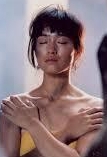 Yimou’s
second landmark work, 1990’s “Ju Dou,”
was the breakout film for this movement, that filmmaker
and his muse and star, Gong Li. A film festival darling
— I first saw it at the 1990 New York Film Festival
— that would become an Oscar nominee, it was the
hit that paved the way for “Raise the Red Lantern,”
“Farewell, My Concubine,” “Hero,”
“The Emperor and the Assassin” and the masterpiece
of that generation of movie-makers, “House of
Flying Daggers.”
Yimou’s
second landmark work, 1990’s “Ju Dou,”
was the breakout film for this movement, that filmmaker
and his muse and star, Gong Li. A film festival darling
— I first saw it at the 1990 New York Film Festival
— that would become an Oscar nominee, it was the
hit that paved the way for “Raise the Red Lantern,”
“Farewell, My Concubine,” “Hero,”
“The Emperor and the Assassin” and the masterpiece
of that generation of movie-makers, “House of
Flying Daggers.”
“Ju
Dou” is, on its surface, a simple love triangle,
a Chinese melodrama with a hint of “The Postman
Always Rings Twice” about it. But setting this
story in a 1920s rural dye works, full of color and
with just a handful of characters — an abusive
older husband (Wei Li), the much younger wife (Gong
Li) he “bought” to sire an heir and the
nephew (Baotian Li) whom the old man took in and basically
enslaved as his loyal, overworked servant and labor
force — is our clue to dig deeper for its true
meaning.
Downtrodden
“nephew” Tianqing is instantly infatuated
with Ju Dou, even gouging out peep holes to spy on her
bathing. She picks up on this and tries to foil it,
for a time. As he cannot help but notice her bruises
and overhear the screams from her nights with her husband
Jinshan, he doesn’t just lust for her. He fears
for her.
She
plays on this, eventually asking if Tianqing will “let
him kill me?” As work progresses and fabrics are
dyed in glorious golds and satin reds, the two give
in to temptation. A baby is born, and it probably isn’t
Jinshan’s.
And
then the old man comes to harm and faces a paralyzed
future, topped off by his bride taunting him with the
news that his bloodline will die with him and that her
son with his adopted nephew will inherit his business
and family name.
Things
turn even messier than that.
The
lore surrounding these films was the currency of film
festivals of the ’90s, that China was the last
place on Earth to worship at the shrine of traditional
Technicolor, that getting these movies made was an act
of defiance and only the most subtle jabs at the Chinese
dictatorship could slip by censors and out of the country.
“Ju
Dou” has an attention to detail, the “mise
en scene” of set dressing and filming of an ancient,
human-and-animal-powered dye works, a world of folk
medicine, village gossip, rites and traditions, that
raised the bar for the period pieces of Zhang and Chen,
their contemporaries and the Chinese filmmakers to follow.
And that attention to detail reminds us that nothing
is on screen by accident.
So
the choices of colors, the conditions of the lives of
the enslaved and those who keep them under their thumbs
have meaning. It’s a life under totalitarianism
allegory.
Gong
Li, Zhang’s “discovery,” muse, lover,
later wife and then ex-wife, became an international
star thanks to her association with Zhang Yimou, making
films such as “To Live” with Zhang and “The
Emperor and the Assassin” with Chen Kaige, working
in Hollywood and often speaking out against the Chinese
regime.
Zhang
once told me in an interview his secrets to making her
into a beauty icon. “Never schedule scenes with
your leading lady in the morning,” he said through
a translator. “Sleep” was the key to getting
the sort of facial perfection Gong presented on screen.
Great acting came easiest for a well-rested, confident
of her image star.
Most
of the Chinese filmmakers of that era, even Hong Kong
icon John Woo, made their peace and “learned to
love Big Brother,” as Orwell put it, in their
later years. They turned conservative and later interviews
with Chen, Zhang and Woo and even stars like Jackie
Chan would be peppered with Chinese government talking
points about the importance of “order” and
“getting along” in The State and with The
State.
The
Fifth Generation filmmakers and their peers rocked the
boat, and those who followed have been more tightly
controlled, so the accepted wisdom goes.
But
thanks to a newly-restored and re-issued (by Film Movement)
“Ju Dou,” we can still revel in the works
of one of the greatest eras in modern cinema, a golden
age of Chinese film, swathed in red and fraught with
meaning.