We
are all familiar with the expression, “go fly a kite:”
The colloquialism roughly translates to: leave me alone,
stop bothering me, be somewhere else than here. The
equivalent in Arabic is “go sweep the desert.”
From
its origins in China in the 5th century B.C. to its
eventual global embrace, the activity of kite flying
has served purposes far beyond amusement. Besides the
fascinating balletic dance between the kite and its
invisible partner, the wind, the science of getting
a kite airborne answers to our deepest longing to join
our flying friends for whom the lower heavens are home.
Kite
flying, with no strings attached, also illuminates our
incurable obsession with territory and the species compunction
to be in control of the entities and persons within
our purview.
It
could be argued that the transformation of kite flying
from a simple hobby into a tool for scientific inquiry
and then into a method of ritualized combat lays bare
man’s thraldom to his nature.
The
prototype of the kite was probably inspired by observing
dried leaves or loose flower petals being picked up
by the wind and sent sailing through the lower skies,
and higher on up, the mesmerizing arcs and dives performed
by the various bird species for whom gravity has no
purchase. As man gazed upwards, his imagination was
captivated by the grace and autonomy of our feathered
friends and their absolute dominion over their boundless
aerial domain.
Inevitably,
man’s ‘awe’ of flight morphed into ‘envy,’ and the kite
was born, immediately satisfying two primordial desiderata.
It became the means to the vicarious experience of flight,
the science of which would eventually produce mechanical
flight, and unlike with the birds, man, with his world
on a string, could control the kite.
While
kite flying, both symbolically and lyrically, speaks
to man’s longing for freedom which has been a constant
of human history, it is not without irony that far too
many men have been willing to sacrifice their own lives
for their precious freedoms while showing no compunction
depriving others of theirs. When it comes to kite flying,
much like freedom and its many currents and undercurrents,
strings are always attached.
Tracing
the kite’s genesis and development to the present, the
artless construction of frame, fabric and string has
much to tell about human endeavour: the kite can serve
as both a toy or territorial contrivance.
The
kite quickly became a favourite child’s toy because
flying it is one of the few activities where a child
can exert command, or in psychology-speak, to take revenge
for being under the command of his parents and teachers.
Similarly, the doll is never simply a doll, but a small
girl’s first opportunity to exercise dominion over something.
As children mature and gain more control over their
lives, their playthings diminish in importance, and
are eventually forgotten or consigned to the attic.
Control is power, and the longing for it invariably
defines our relationships with others as well as the
activities we are likely to pursue. Kite flying is a
mirror held up to human nature.
This
theme was taken up by travel writer Paul Theroux in
his novel The Mosquito Coast, which was later
made into a critically acclaimed movie of the same title
with Harrison Ford.
The
book explores the mind-set of a family man who decides
to leave the rat race and go native in the tropics,
only to discover that wherever he goes he can’t escape
his aggressive, hierarchal self.
The
delicate balance between aspiration and manipulation
is central to understanding the kite's enduring appeal.
Less understood is the manner in which kite flying betrays
man’s conflicted self, or as Freud, in Civilization
and Its Discontents, would have it, the individual
torn between his civilized and primordial selves.
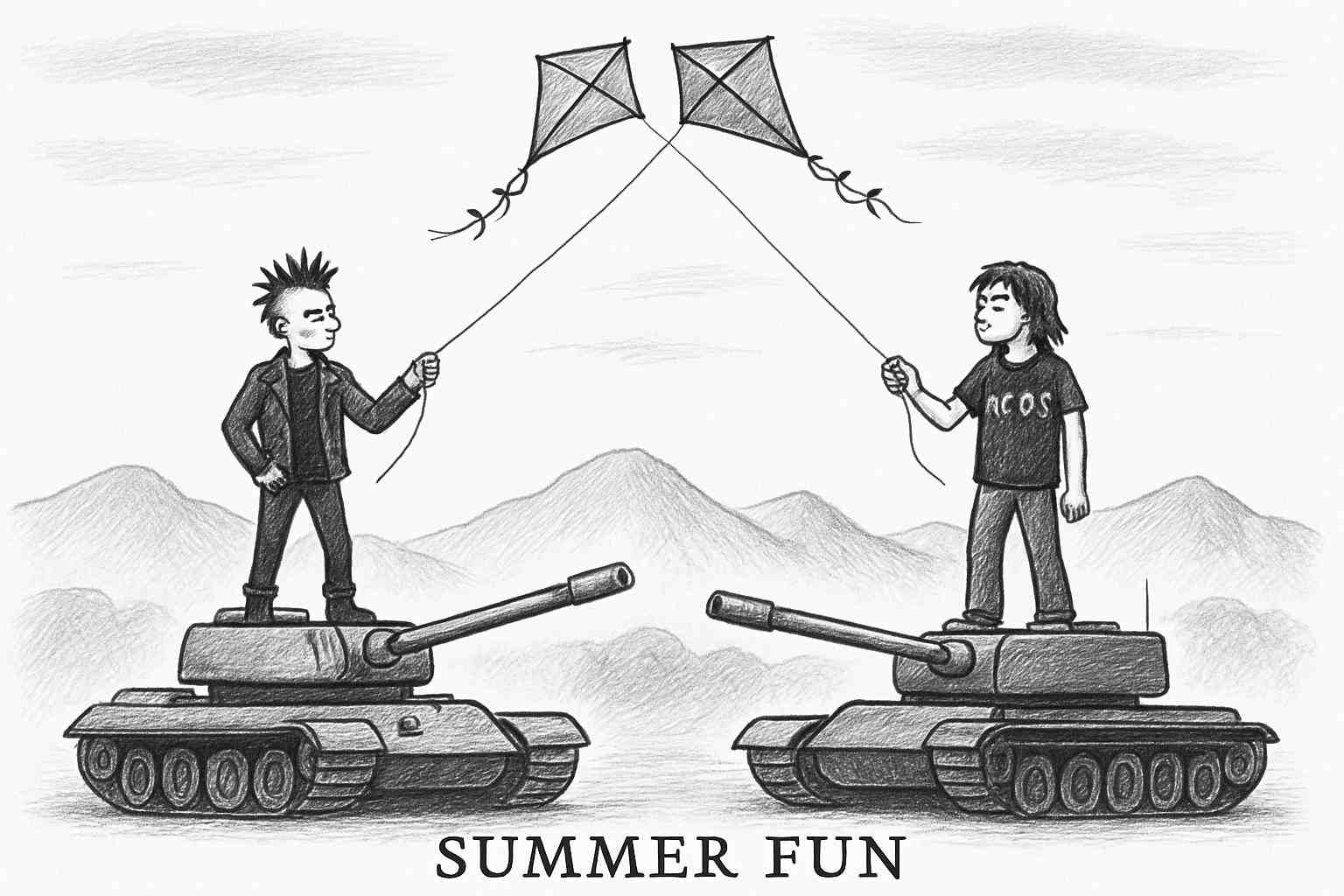 The
history of kite flying, which began in China circa 400
B.C, is an ever present reminder that man is servant
to his nature. If at the outset, the marvellous hand-directed
choreography of the kite was strictly an aesthetic pleasure,
the activity, at some point, was co-opted by man’s competitive
spirit, creating winners and losers in symbolic life
and death scenarios. This likely began inauspiciously,
when a kite flyer objected to another kite intruding
on his self-proclaimed section of sky, sparking the
desire to sever the intruder’s string (the kite’s de
facto jugular).
The
history of kite flying, which began in China circa 400
B.C, is an ever present reminder that man is servant
to his nature. If at the outset, the marvellous hand-directed
choreography of the kite was strictly an aesthetic pleasure,
the activity, at some point, was co-opted by man’s competitive
spirit, creating winners and losers in symbolic life
and death scenarios. This likely began inauspiciously,
when a kite flyer objected to another kite intruding
on his self-proclaimed section of sky, sparking the
desire to sever the intruder’s string (the kite’s de
facto jugular).
In
kite fighting competitions, one kite destroys another
by using the kite line, which the flyer coats in abrasive
materials comprised of micro-splinters of glass and
glue, to cut the opponent's string. The objective is
to maneuver the kite and bring the razor sharp line
into contact with the adversary’s line, delivering a
clean cut to the kite’s life line sending it plummeting
to the ground, where, we note, it will be restrung and
reborn and live to see another day – a happening that
is analogous to the promise of the afterlife in religions
and cartoon culture. In the kite, hope springs eternal.
India
was the first country to transform kite flying into
a sport, and then, circa 800 A.D. Afghanistan formalized
kite fighting competitions that eventually became international
in scope. In kite fighting, man finds himself in the
truth of his being, where even in the boundless skies
he cannot overrule his territorial nature before which
he is both mute and marionetted.
The
kite is not merely an instrument of liberation, but
as a paradoxical construct, kite flying appeals to our
penchant for absolute control. If the bird is an agent
of its own will, the kite is a puppet, its every dip
and soar consequent to the unseen hand on the ground.
As a mirror to our conflicted selves, it reflects our
dreams of freedom as well as our compulsion to tighten
our grip on the world. As the study of kite flying facilitated
our understanding of aerodynamics, it underscored a
deeper psychological truth that in our pursuit of the
sublime, we are unable to escape the impulse to assert
our dominance and impose our will on the natural order.
The
rite of kite fighting, played out against the backdrop
of the heavens, illustrates how deeply ingrained is
the competitive spirit within the human psyche, and
how this incorrigible impulse can transform even the
most innocent of activities into a contest of wills,
a struggle for supremacy.
As
yet another reveal onwhat it means to be human, kite
flying embodies our dreams of transcendence as well
as our obsession with dominance. It reminds us that
even as we reach for the heavens, we remain earthbound,
bowed by the weight of our desires, rivalries large
and small, and inner conflicts; and our unquenchable
quest for meaning in a world that in the vastness of
the universe, registers as a mere twinkle in the night
sky.
The
first truth of kite flying is that man is servant to
his nature whether on the ground or in ascension.