A
few years ago, my teenager had some friends over for a
Super Bowl party. They were their usual polite, sweet
Zoomer selves—airy, relaxed, buzzing with party
energy. They kibbutzed and cracked jokes, then disappeared
upstairs to watch the game. At halftime, I came up with
some cold drinks and snacks. This was presumably after
they’d broken out the edibles and vapes because,
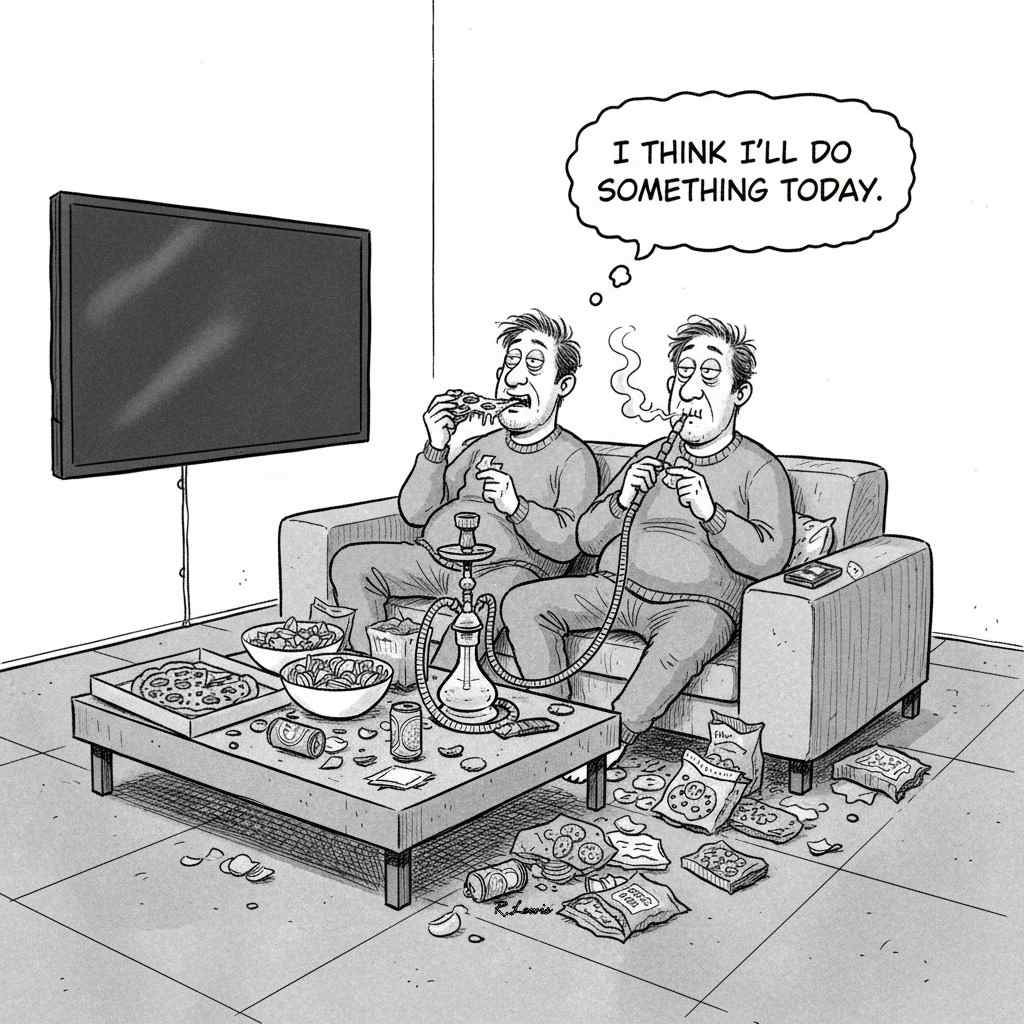
and I do not exaggerate when I say this, someone pushed
the eject button on their brains. These were different
kids, completely drained of all the boisterous energy
and camaraderie; hypnotically fixed on the TV, immobilized
by stoner self-awareness.
That’s
when it began to dawn on me how much I hated weed—a
realization that came on slowly but has been gaining steam
every day since Justin Trudeau passed Bill C-45. Now I
hear Trump has plans to reclassify it as a Schedule III
drug, and all I can say is . . . don’t bother.
 I
literally hate everything about the jazz parsley. Everyone
I know also hates it, even those who like it. We complain
about weed’s nasty effluvium pervading our city
streets, especially where high school kids are gathered.
We all know weed is among the top—if not the actual
top—reasons Zoomer boys aren’t living up to
their potential and we’re always shocked to see
their fresh, still gestating minds exposed to the paralyzing
effects of Quantum Couchlock or Kryptonite Kush—in
the morning, no less.
I
literally hate everything about the jazz parsley. Everyone
I know also hates it, even those who like it. We complain
about weed’s nasty effluvium pervading our city
streets, especially where high school kids are gathered.
We all know weed is among the top—if not the actual
top—reasons Zoomer boys aren’t living up to
their potential and we’re always shocked to see
their fresh, still gestating minds exposed to the paralyzing
effects of Quantum Couchlock or Kryptonite Kush—in
the morning, no less.
Repulsion
of weed is another of those subjects exhausted among normies
and totally ignored by mainstream media, similar to topics
like “mass unchecked immigration.” Though,
to its credit, MSM abandoned the notion of weed as a medical
panacea when the evidence failed to stack up. The only
symptom it seems to alleviate is insomnia. But if you
want to fall asleep, just talk to someone baked out of
his mind.
Here’s what I’ve come to learn about the decades-long
efforts to normalize the devil’s lettuce.
It’s
a big part of the Great Enshitification
Weed
normalization really took off (coincidentally???) right
as Covid lockdowns turned our cities into something out
of The Walking Dead—and they’ve never quite
snapped back.
Around
that same time, city life in general turned shittier:
more homeless encampments, more fentanyl casualties, more
inflation, more urban edge. And, like clockwork, on every
corner—from Vancouver to Portland to Denver to my
own hometown—a dispensary popped up, often replacing
what used to be a cozy Italian café or a charming
little bookstore.
Toronto,
once scented with ambition and hot pavement, now reeks
of skunk spray and squandered potential. I should say
‘Toronto and beyond’ because there’s
at least one weed store in every town you visit.
DECRIMINALIZATION
IS A LUXURY BELIEF
Rob
Henderson’s phrase ‘luxury beliefs’
does a good job of describing a certain pattern: bad ideas
cooked up in elite universities, where the people floating
them enjoy a kind of cultural or moral status for pushing
them. The trouble is, those same ideas often come with
costs that fall hardest on people without the money, privilege,
or social buffer to absorb the damage. (Climate change
is a great example—no sun holidays for you, peasant!).
That’s
not to say plenty of well-off families aren’t also
tearing their hair out over kids hooked on weed. The difference
is, they usually have more resources to cushion the fallout—things
like pricey rehab programs or private schools that can
still smooth an otherwise bumpy path to college.
Weed
normalization may be the ultimate ‘luxury belief’
initiative ever, since its most deep-pocketed sponsor
has a net worth of $7.2 billion. Which brings me to the
next reason I loathe it so much…
NEVER
A GRASSROOTS MOVEMENT
Nothing
about weed’s normalization happened organically.
Like so many “progressive” ideas that end
up hurting ordinary people, billionaire George Soros has
funneled millions into the movement. He’s the same
guy behind other civic disasters dressed up as reforms:
defunding police and lighter sentences for criminals.
Soros
launched his ‘legalize weed’ campaign back
in 1996 and hasn’t stopped writing cheques ever
since. He funded a medical marijuana initiative in California—the
state that seems to export all the worst ideas—and
kicked in $1 million for Proposition 19, a full recreational
legalization measure. He also spent $400,000 on Massachusetts’
Committee for Sensible Marijuana Policy. All told, he’s
poured around $200 million into drug policy reform, including
neighborhood-shredding “harm reduction” programs,
with roughly $25 million aimed specifically at weed.
IT’S
NO LONGER COMEDY GOLD
Weed
was once a reliably funny sight gag in movies. Judd Apatow
and Seth Rogen’s “Pineapple Express,”
Kevin Smith’s “Jay and Silent Bob” in
Clerks and “Harold & Kumar’s Go to White
Castle” adventures all leaned on stoner hijinks.
Having lost its transgressive edge, weed is no longer
funny. That is true for the unintentional laugh riot that
is “Reefer Madness,” the 1936 propaganda film
designed to scare everyone into believing even one haul
of hippie hay would launch any clean-cut kid into a jazz,
sex, violence and murder doom spiral.
Although
this is admittedly hilarious . . .
When everybody’s mom has gummies in the freezer,
it’s no longer taboo or outrageous—just…
Tuesday.
What
everyone knows is that ‘wheelchair weed’ is
a completely different animal from yesteryear. Back then,
your average variety contained a 4% THC strength, just
strong enough to work up some profound thoughts about
the clouds. Years of cross-breeding birthed a botanical
wrecking ball, routinely testing at 25% THC and packaged
into gummies that could tranquilize a moose. What used
to be a mellow social lubricant is something that can
now render you horizontal, staring at the ceiling, wondering
if your cat is plotting to kill you.
Healthcare
workers and first responders can tell you all about how
experimenting with high-potency weed sometimes ends in
full-on psychotic freakouts, and yeah… occasionally,
murder. We are talking about completely normal people
becoming convinced their loved ones are possessed, seeing
things that aren’t there, totally untethered from
reality.
Ask
these workers about the well-known phenomenon of “scromiting,”
or simultaneously ‘screaming’ and ‘vomiting.’
The portmanteau is definitely more visual than its formal
name—Cannabinoid Hyperemesis Syndrome (CHS).
WEED
STARTUP BRANDING IS EXECRABLE
Out
to prove that even the worst hobbies can be spun into
a lucrative empire, Silicon Valley hustlers draped their
Wall Street bonanza in the buzzword cloak of “disruption,”
along with all the techy appurtenances, like iPhone packaging
and pretentious language (“premium artisanal flower”).
Like scenes from Mike Judge’s satire, Silicon Valley,
they draped themselves in noble language and a lot of
self-congratulation, as though they’d invented an
herb that predates history.
Vancouver’s Choom Cannabis shamelessly borrowed
from Obama’s stoner cachet, lifting the name from
his memoir Dreams from My Father, where he recalls the
“Choom Gang”—his dope-smoking crew in
Honolulu, “Choom” being their slang for weed…
Ooh, look—a long board and a living wall and ermigad
is a VW Type 2 Microbus replica. Wow, so cool! Seriously.
The
Apple Store lighting isn’t fooling anyone. We all
see these shiny boutiques for what they are—tarted
up OG head-shops of the kind once tucked between porn
rentals and pawn shops on seedy downtown streets.
Honestly,
that the great green gold rush fizzled gave me no end
of schadenfreude. Perhaps high on their own supply, these
investors never anticipated a market glut or that the
government would fumble deregulation.
So
when I say ‘I hate weed,’ I’m not
being hyperbolic. I really hate it. Its normalization
has been a betrayal of every aspect of civil life.
But its true odiousness lies in its palliative nature.
Weed smokers who feel their lives are shitty will
find their shitty lives just tolerable enough that
they no longer feel compelled to do anything to improve
them.
Having
burned a few reefers in my time, I was for legalization.
Figured why not? I used all the typical justifications;
it's not as bad as alcohol, it's natural, nobody ever
got in a fight while stoned, it just makes you tired and
hungry . . . .Well I'll tell you, with how strong it is
these days, the paranoia and psychosis it induces is real.
I'll still smoke a bit from time to time, but legalizing
was wrong. Shoulda just left it in the shadows. It hasn't
helped society overall, that much is clear.
What
you allow you encourage. That's the lesson.
READER FEEDBACK