In
many parts of the African continent, love between women remains
one of the most silenced and dangerous truths. While LGBTQ+
identities have existed in African cultures for centuries,
the modern experience of being a lesbian in many African nations
is characterized by a brutal struggle for survival against
deep-seated prejudices, systemic violence, and state-sanctioned
discrimination.
 Understanding
this landscape requires looking beyond the headlines to the
human cost of living in societies where sexual orientation
is often framed as a "foreign import" or an affront
to traditional values.
Understanding
this landscape requires looking beyond the headlines to the
human cost of living in societies where sexual orientation
is often framed as a "foreign import" or an affront
to traditional values.
To
understand the hostility faced by lesbians in Africa, one
must look at the intersection of colonial history, religious
dogma, and cultural essentialism.
Many
contemporary anti-gay laws across the continent are legacies
of colonial-era penal codes, originally imposed by European
powers to control local populations. These laws, once intended
to govern colonial subjects, have been repurposed by some
modern African leaders as tools to promote "national
purity."
This
political rhetoric is frequently bolstered by conservative
religious organizations—both Christian and Islamic—which
often preach that same-sex attraction is a violation of religious
law. By framing lesbianism as "un-African," these
institutions effectively strip women of their cultural belonging,
painting them as outsiders who threaten the foundational structure
of the African family unit.
For
a woman living in a country where homosexuality is criminalized,
the "price" of living authentically is often the
loss of everything.
Social
Ostracism: Being "outed" often leads to immediate
rejection by family, the loss of employment, and expulsion
from schools or housing.
In
countries with strict anti-LGBTQ+ laws, women can face long
prison sentences, hefty fines, and public shaming. The threat
of arrest hangs over their heads, making them vulnerable to
extortion by police and community members.
Psychological
Toll: The need to remain in the "closet" creates
a life of constant anxiety. The mental health consequences
of living a double life, fearing discovery by neighbors or
family, can lead to severe isolation and depression.
CORRECTIVE
RAPE
Perhaps
the most harrowing aspect of the lesbian experience in many
African regions is the prevalence of gender-based violence.
Women who express their sexuality are often targeted as a
way to "reclaim" or "discipline" them.
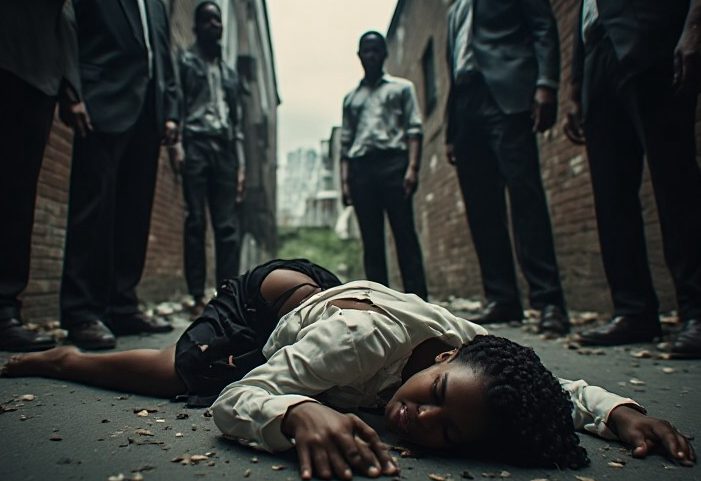
The
most extreme and devastating manifestation of this is "corrective
rape." This is a hate crime in
which lesbians are raped by men, sometimes with the tacit
approval or encouragement of their communities, under the
false and violent pretense that the act will "cure"
them of their sexual orientation and "turn them straight."
 Corrective
rape is not only a physical violation; it is a tool of terrorism.
It is designed to silence, punish, and traumatize women into
compliance with heteronormative societal expectations. Because
of the stigma surrounding both rape and lesbianism, many victims
find it impossible to report these crimes to the authorities.
When they do, they are often met with disbelief, victim-blaming,
or even further abuse by the very police officers sworn to
protect them.
Corrective
rape is not only a physical violation; it is a tool of terrorism.
It is designed to silence, punish, and traumatize women into
compliance with heteronormative societal expectations. Because
of the stigma surrounding both rape and lesbianism, many victims
find it impossible to report these crimes to the authorities.
When they do, they are often met with disbelief, victim-blaming,
or even further abuse by the very police officers sworn to
protect them.
Despite
these systemic barriers, the narrative is not solely one of
victimhood. Across the continent, lesbian activists and grassroots
organizations are doing the dangerous, life-saving work of
organizing.
From
South Africa, which has some of the most progressive LGBTQ+
constitutional protections in the world—though it still
faces high rates of violence—to underground networks
in countries like Nigeria, Kenya, and Uganda, women are finding
ways to build community.
The
struggle for lesbian rights in Africa is fundamentally a struggle
for basic human rights. It is about the right to exist, the
right to bodily autonomy, and the right to live free from
violence.
International
pressure, while sometimes controversial, often plays a role
in keeping the spotlight on these abuses. However, the most
effective change is consistently driven from within the continent.
As more African women occupy spaces of influence and as younger
generations grow up in an increasingly connected world, the
rigid boundaries of the past are beginning to be questioned.
The
path toward equality remains treacherous, and the cost of
the status quo remains far too high. Yet, the courage of those
who choose to live openly—and those who work quietly
in the shadows to protect their communities—serves as
a powerful testament to the resilience of the human spirit.
Their fight is a reminder that the pursuit of dignity is a
global necessity, one that will not be silenced by the prejudices
of the present.