Robert
Lyon is a retired clergyman who divides his time between
Guelph, Ontario and Melaque, Mexico. He taught high
school English, Latin, Greek and science, and served
as an officer in the Canadian Armed Forces Reserve,
retiring in the rank of Lieutenant-Colonel. His latest
book, Don't Throw Out Your Bible, is now
in print.
I want you to visualize a cartoon. Single frame. Two guys
in a small room. At one end of the room is a double-bunk
bed One of the guys is sitting on the top bunk; the other
is slouched in the lower one. You know where they are
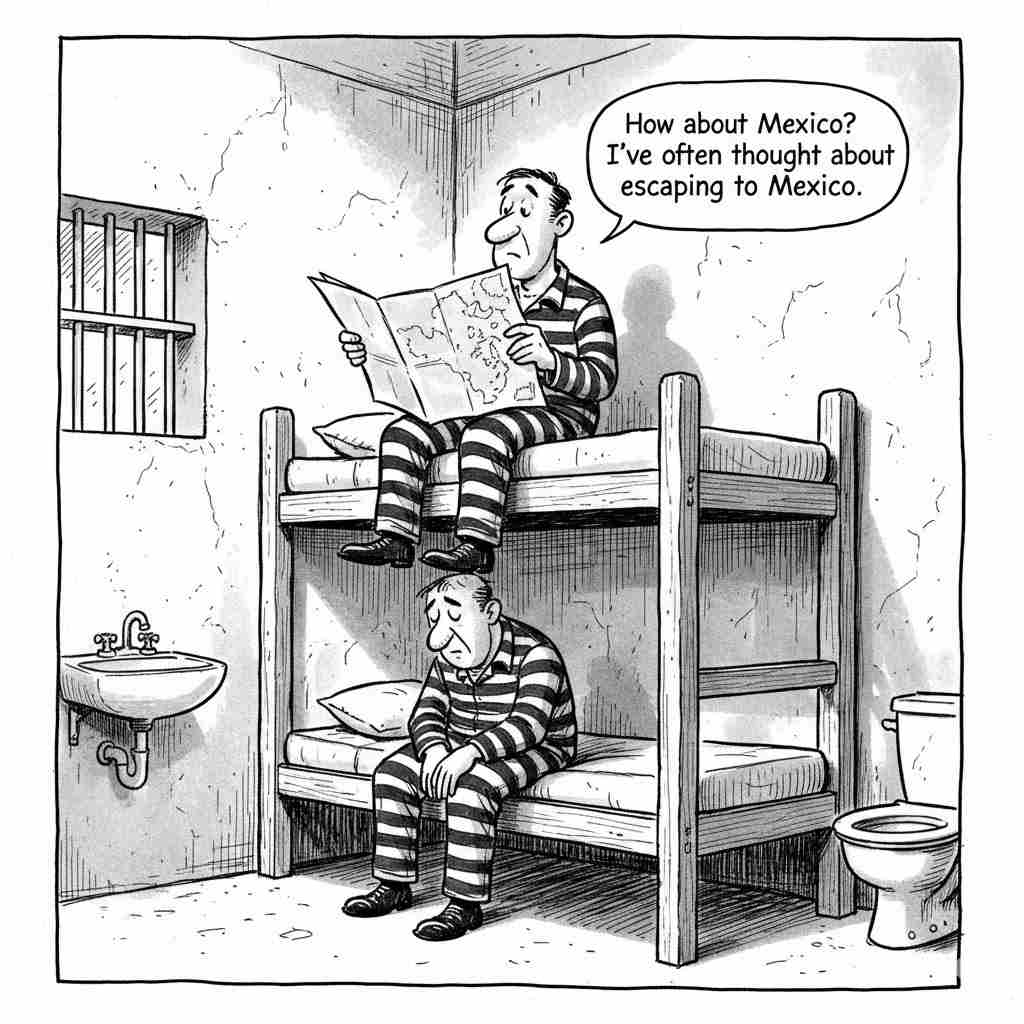 because
there are bars on the window and they’re both wearing
jump suits with black and white stripes. The fellow on
the top bunk is looking at what appears to be a book of
maps. He says, “How about Mexico? I’ve often
thought about escaping to Mexico.”
because
there are bars on the window and they’re both wearing
jump suits with black and white stripes. The fellow on
the top bunk is looking at what appears to be a book of
maps. He says, “How about Mexico? I’ve often
thought about escaping to Mexico.”
So
the topic that I want to consider with you this morning
is in the form of a question: Why do we ex-pats come to
Melaque? That may not seem like a very spiritual question,
and hardly a topic for Sunday morning church. but as they
say on the YouTube programs, If you stick around to the
end, I’ll show you how that question invites a consideration
of this morning’s gospel reading. And if it should
generate some discussion in days to come, so much the
better.
But
before we go there, I want to share with you something
that’s curious about the text of this morning’s
gospel. You know how at the end of John 20 the writer
says: “There are many other signs that Jesus did
that are not written in this book.” Well, strange
as it may seem, this morning’s reading is one of
those “many other” things that were “not
written in [John’s] book.”
And that requires some explanation.
In
the 414 years since the King James Version was translated,
archaeologists have discovered many previously unknown
manuscripts and fragments of the New Testament from the
earliest years of the church – some of them much
earlier than the manuscripts from which the King James
Version was translated. At current count, we have about
5000 manuscripts and fragments of the New Testament from
the earliest centuries; that’s vastly more evidence
for the New Testament than we have for any other work
of ancient literature. But what you don’t find in
the earliest manuscripts is this story about the woman
caught in adultery.
The
story does occur in later manuscripts, say late 2nd century
and beyond. Sometimes it’s here in John 8 where
we have it inb our Bibles; sometimes you find it at other
places in John’s gospel; and in a few manuscripts
it appears at the end of Luke 21. So what we have here
is a Jesus-story that circulated orally among the early
Christian communities until one or two copyists recognized
its importance and, thankfully, were inspired to preserve
it. We’ll come back to that later.
But
for now, let’s return to our question: Why do people,
especially people of our age, come to Melaque, or Barra
de Navidad, or La Manzanilla, or any place like this?
Well, it’s warm; it’s affordable (still);
life here moves at a slower pace; some of us manage to
find a sense of community here that we never had up North;
and some of us, including our friends and neighbours who
don’t “do church”, are like the guys
in the cartoon: we come here to escape.
We
come to escape – from some kind of loss, from disappointments,
from bad memories, from relationships that didn’t
work, from failures, or even from successes that took
too much out of us. And I’m sure you can add to
that list.
But
if you put all those reasons together and look for the
common element, I would suggest that many of us come here,
whether we realize it or not, to heal. Many of us, each
in our own way, whether we know it or not, whether we’re
doing it successfully or not, are on journeys of healing.
I didn’t clue into that until a couple of years
ago, when I came to realize that it was true of me.
So
let’s look at this orphan gospel story and see what
it might have to say about healing. The scribes and the
Pharisees who brought this young woman to Jesus –
these guys in their day were the Bible scholars and the
leaders of religious orthodoxy. So they charge this young
woman with adultery and, based on the law of Moses, they
say she should be stoned to death. Apparently. the young
woman was engaged but not yet married, because for a married
adulteress the rabbis specified death by strangulation.
(Just as an aside, it may have occurred to you that it’s
pretty hard to commit adultery all by yourself. So you
can read what you will into the fact that these guardians
of orthodoxy didn’t bring “the guy”
to Jesus, as well.)
Now,
we don’t know anything about this young woman. Was
she a tramp? Did she sleep around? Or was this maybe a
desperate last go with the guy she really loved, before
she was forced into some family arrangement that she didn’t
want? We don’t know, and if the scribes and Pharisees
did know, they didn’t care. Just keep the rules;
fulfill the law; that’s all that mattered. But I’m
thinking there must be more to her story than meets the
eye. As indeed there is to most of our stories.
Well,
what about these men who brought her? They must have known
that under Roman law, as they were then, they couldn’t
carry out any kind of execution. So what’s their
game? They want to discredit Jesus. If he disagrees with
Moses, they’ve got him! He’s not a “real
bible-believing Jew”. He’s some kind of flaky
liberal with a new-fangled theology that you can’t
trust. And a guy like that certainly can’t be the
Messiah!
The
relationship, if I can use that word loosely, between
the young woman and her accusers, reminds me of stories
I’ve heard from some of my friends here in Melaque,
friends who were brought up in Christian churches but
don’t do church any more. A couple of them were
raised Roman Catholic; another one was raised Southern
Baptist. But what they all tell me is that the picture
of God that they got from their clergy, from Sunday school,
from their relationship with their fathers and other church
folk was the picture a policeman-God who was always looking
for reasons to be angry at them. That’s the same
sort of God that these scribes and Pharisees reflect.
You certainly wouldn’t want to have grown up being
one of their children !
On
that same note, I knew a Jewish man a few years ago who
had abandoned his Jewish roots for a new age faith that’s
a sort of cross between Buddhism and Christian Science.
He tells the joke that “It was we Jews who invented
the idea of sin – but it was those Catholics who
perfected it.” Of course, instead of Catholics,
he could just as easily have picked on any number of Protestant
groups. But either way, does the picture of God that our
lives portray to our families and neighbors match the
picture of God’s grace that we tell with our words
?
On
the flip side of those stories, I recall a couple of foreign
ladies who came several times to our church in Hamilton
a dozen years ago. They may have been Muslim, or Hindu;
we were never quite sure. Anyway, the pastor welcomed
them warmly and asked them as tactfully as he could why
they had come. Their reply? “Because your God is
kinder than ours.” Let that sink in: “Because
your God is kinder than ours.” For the brief few
weeks while they were in Hamilton, St George’s Church
was their Melaque, where they came to heal, and where
they could believe that somewhere at the highest level
of the universe, they were seen, they were known, and
they mattered.
Now,
back in the day when stoning was in vogue, the convention
was that the accusers should be the ones to throw the
first stones. So when the scribes and Pharisees propose
stoning, Jesus stoops down and begins to doodle in the
dirt, meaning that he is not going to play their game.
Then in a brilliant piece of one-up-man-ship he invites
whoever among them is without sin to start the process.
And of course, we’re told that they all go away.
Then Jesus asks the young woman, “Where are your
accusers? Did no one condemn you?” and you can hear
her astonishment in that two-word reply, “Nobody,
sir.”
In
that brief but scary encounter, she got a new picture
of God. A healing picture. Not of an angry God, but of
a God about whom she could have said to Jesus –
as the ladies in Hamilton said to the pastor – “Your
God is kinder than ours.” And if she had used a
line like that, Jesus could quite properly have replied,
“Yes, I am.”
For
all of us who carry burdens of fear, or guilt, or loss,
or failure, or some crummy opinion about our own self-worth,
the ultimate healing occurs when we discover in Jesus
the God who does not throw stones.
So
what’s the take-away from this story for you and
me? It’s this: There’s lots of hurting people
here in Melaque. Some of them are in our church; some
may be in your own family; some of them are our friends
and neighbors outside the church. Some of them don’t
look like they’re hurting, and some of them may
not even recognize that they’re hurting. Most of
them, I suspect, are metaphorically like our gospel story
itself: spiritual orphans, whose value someone needs to
recognize, and to help them find for themselves a place
in God’s good and bigger narrative.
So
today’s gospel is (among other things) about how
we “do church”: not here in the sanctuary,
but how we “do church” with one another, and
how we “do church” with our friends and neighbors
who don’t “do church”. It’s about
doing the Jesus thing. It’s about showing compassion
to those among us who are unloved, unseen, unheard, unwanted.
it’s about being an instrument of God’s peace
to people we don’t like, and to people who don’t
like us, and maybe most importantly to people who don’t
like themselves – not from any sense of our own
superiority, but from knowing that, just like them, we
too are on journeys of healing.
And
then, as I’ve discovered in my last few years here,
a strange thing happens: In the past we might have been
the ones casting stones, whether in the form of words
and looks, or in the form of stony silence and looking
away. But as we recognize and try to support one another
on our healing journeys, God blesses our own healing,
and we grow together as a community in the Spirit.
And
that seems to me to be a good reason for coming to Melaque.
So may the Lord be among us, bless the time that we share
here, and show us how to make this church and this community
a refuge where healing souls discover God’s peace.
READER FEEDBACK