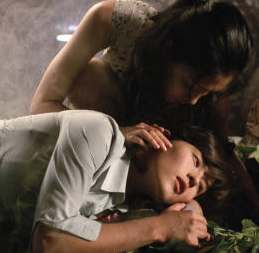
 At
the suggestion of the editor, I rented the DVD The
Chinese Botanist’s Daughter, directed by Dai
Seijie, who first gained international recognition with
his exotic Balzac and the Little Chinese Seamstress
(2002). The film played at the 2006
Montreal World Film Festival.
It didn’t take long to fall in love with the breathtakingly
gorgeous, lush green landscape, and as the film developed,
the two sensuous lesbians that were the subject of the
film: forbidden love in China.
At
the suggestion of the editor, I rented the DVD The
Chinese Botanist’s Daughter, directed by Dai
Seijie, who first gained international recognition with
his exotic Balzac and the Little Chinese Seamstress
(2002). The film played at the 2006
Montreal World Film Festival.
It didn’t take long to fall in love with the breathtakingly
gorgeous, lush green landscape, and as the film developed,
the two sensuous lesbians that were the subject of the
film: forbidden love in China.
But being
engrossed by a film doesn’t necessarily mean it
was good, so I decided to let several weeks pass before
writing it up.
If most good
films are the sums of their characters and characterizations,
two of the four characters are woefully stereotyped: the
strict, intolerant botanist father to one of the lesbians,
for whom herbs and plants are as deserving of his attention
as his daughter; and the son, who, on leave from the army,
believes he has fallen in love with Min Li (played by
Li Xiaoran), an orphan who has come to study with the
botanist. The brother's gross insensitivity and brutal
manner are so clichéd as to be almost laughable.
And when it comes to being numb-dumb to feedback, his
not getting it stretches the limits of credulity: he not
only doesn’t notice the girl he wants to marry can’t
stand him, but that she’s in love with his sister.
But despite
these character mishaps, the tastefully developed and
totally engaging off-limits love affair between the precious
Mi Li and sympathetic Cheng An (Li Xiaoran) allows the
film to soar above its uneven parts.
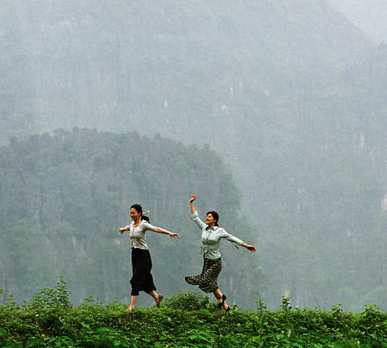 Co-staring
in this highly affecting tale of two worlds is the landscape,
both seen and heard. Woven into their relationship is
the exotic flora that rustles and shimmers against their
bodies as they explore their environment and each other,
the mist that soft scarves them, and the sounds of cool,
trickling water the hot flesh can’t refuse.
Co-staring
in this highly affecting tale of two worlds is the landscape,
both seen and heard. Woven into their relationship is
the exotic flora that rustles and shimmers against their
bodies as they explore their environment and each other,
the mist that soft scarves them, and the sounds of cool,
trickling water the hot flesh can’t refuse.
Eventually
the father catches them in the act, and the brother, now
married to Min Li, must beat her up to redress his humiliation.
As for the lovers, since lesbian love cannot survive the
prevailing winds in China, the only viable option for
Min and Cheng is the best and worst of both worlds.
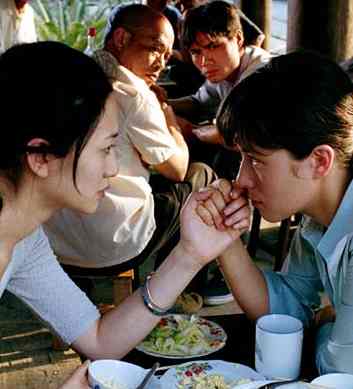 So
with a plot thinner than rice paper, why am I still recommending
this film? Because it does what all good films are supposed
to do: get you to get involved with and care about the
characters. Despite the films many lapses into melodrama
and the underwritten male characters, the viewer cannot
help but to empathize with these very decent young women
as women, who, before they are lesbians are people who
love and care for each other. What makes this film linger,
or rise above its many flaws, is that it sheds light on
what is tragic in the human condition that especially
concerns couples who care deeply for each other, but,
because of circumstance, are not able to consummate their
caring. Seijie’s skillful and sensitive rendering
of what the Greek’s understood by tragedy –
an event that is all too rare in film today -- insists
that I give this film 3.5 out of 5 stars.
So
with a plot thinner than rice paper, why am I still recommending
this film? Because it does what all good films are supposed
to do: get you to get involved with and care about the
characters. Despite the films many lapses into melodrama
and the underwritten male characters, the viewer cannot
help but to empathize with these very decent young women
as women, who, before they are lesbians are people who
love and care for each other. What makes this film linger,
or rise above its many flaws, is that it sheds light on
what is tragic in the human condition that especially
concerns couples who care deeply for each other, but,
because of circumstance, are not able to consummate their
caring. Seijie’s skillful and sensitive rendering
of what the Greek’s understood by tragedy –
an event that is all too rare in film today -- insists
that I give this film 3.5 out of 5 stars.